Facts and evidence
What is documented, what remains open and which information is missing.
We advise businesses, entrepreneurs, families and fellow professionals on complex tax matters. Legal experience and artificial intelligence work together to reconstruct the facts, verify sources and assess the alternatives.
Technology broadens the analysis. The lawyer checks, decides and takes responsibility.
A tax assessment, collection notice or procedural deadline: first identify the document and the time available.
Support during inspections, investigations and discussions with the authorities.
Tax audits and pre-litigation ↗
Transactions, wealth and international arrangements requiring reasoned, documented alternatives.
Opinions, strategy, drafting and co-counsel within a clear scope and with respect for the client relationship.
A shared protocol, proportionate to the case, connects documents, sources, alternatives and decisions through to final validation. The content and depth of the work are agreed for the engagement.
What is documented, what remains open and which information is missing.
The reasons for the recommendation, its limits and the factors that could change it.
Activities, priorities and deliverables agreed together, with a defined financial scope.
The agreed opinion or procedural document, checked by the responsible professional.
Support during investigations, discussions with the tax authorities and the assessment of settlement options.
We help businesses and their advisers understand the issues raised during a tax audit, reconstruct the facts and prepare a documented response before positions become entrenched.
Representation before the Italian Tax Courts and the Supreme Court of Cassation.
We develop a defence that connects the disputed issues, the evidence and the procedural position. The strategy is assessed against the client’s financial exposure, objectives and alternatives to continuing the proceedings.
A coordinated strategy across investigations, tax proceedings and criminal proceedings.
Where the same facts give rise to tax and criminal issues, we coordinate the analysis, evidence and defence strategy with the lawyers involved in each proceeding.
Cross-border transactions, tax residence, transfer pricing and tax treaties.
International tax decisions require the facts, the relevant jurisdictions and the business objectives to be considered together. We compare the available structures and identify the specialist contributions needed.
Planning for continuity, governance and the transfer of family and business wealth.
We help entrepreneurial families compare arrangements for their assets and businesses, taking account of family objectives, governance, continuity and the associated tax consequences.
Due diligence, transaction structuring and tax aspects of negotiations.
We connect the tax analysis to the objectives and practical steps of a transaction, from the review of documents and risks to structuring, negotiations and post-closing work.
An AI-native method integrates artificial intelligence into the work under the supervision of the responsible professional. Technology extends the analysis; professional judgement remains central.
The depth of each phase depends on complexity, value, urgency and risk. The outputs describe the work: the form and deliverables are agreed with the client and do not require a separate document for every phase.
We organise and classify the available material, identify gaps and define the information to be examined.
OutputAn inventory of the material available and the gaps to address.
Chronology, parties, transactions, supporting documents, disputed facts and matters still to be proved are identified and connected.
OutputA map linking facts, documents and matters still requiring proof.
The issues are broken down and researched using authoritative sources. Every reference relied on must be verifiable.
OutputVerified references relevant to the issues in the case.
We develop the principal and alternative arguments, anticipate objections and assess possible compromises.
OutputA comparison of arguments, objections and practicable alternatives.
Evidence, risks, costs, timing, the client’s interests and possible outcomes are compared before choosing a course of action.
OutputA reasoned choice integrating legal analysis, predictive indicators and financial assessment, with the conditions that may require it to be reconsidered.
Technology supports organisation, consistency checks and initial drafting. The professional directs structure, reasoning and tone.
OutputA draft consistent with the strategy and ready for review.
Sources, factual and procedural consistency, opposing arguments and the final document are checked by the responsible professional.
OutputA version validated by the professional responsible for the matter.
The document or opinion is delivered in the agreed format. Outcomes and feedback inform improvements to the method.
OutputThe agreed document or opinion and the next steps relevant to the engagement.
Strategic simulation develops the alternatives identified in phase 04 and informs the checks in phase 07. It combines legal analysis, assessment of the evidence and predictive analysis to decide whether to continue litigation or initiate an attempt at judicial conciliation.
Consider the strongest objections and distinguish documented facts from inferences and assumptions. Identify arguments to strengthen and documents to obtain.
Assess continued litigation and conciliation on the same information, considering estimated prospects, the strength of the evidence, costs, timing, financial exposure and the client’s objectives.
Examine win rates by court, division, judges, subject matter and specific legal issue. The frequency of favourable outcomes in comparable decisions helps assess the prospects of individual disputed issues and of the case as a whole.
Examine how new evidence, a different line of authority or a proposed settlement affects the assessment and the relative merits of each option. Explain which changes could alter the recommendation.
Court-wide results are examined more closely by division, individual judges or panel composition where identifiable, and by subject matter and specific legal issue. These views may concern overlapping samples: they are not automatically added together or averaged. Panel decisions are considered in the context of the panel’s composition.
Each indicator should identify its sources, the number of decisions, the period observed and the criteria for comparability. Full and partial successes and dismissals are distinguished, as are the outcome of an individual issue and the result of the proceedings as a whole. An insufficient sample does not support a reliable estimate at that level.
A historical win rate describes the sample. A prediction for the individual case assesses how relevant that sample is to its facts, evidence and legal context. The professional explains the reasoning and the degree of uncertainty.
Hypothetical example. A company challenges a tax assessment and has obtained a document that may strengthen its defence. Before choosing its next step, the document’s reliability and admissibility must be assessed and win rates in comparable cases examined by court, division, judges, subject matter and specific legal issue.
A favourable court-wide result may not hold for the decisive issue, the relevant division or the past decisions of the judges on the panel, if its composition is known. The weight of each indicator depends on sample size and the actual similarity of the cases.
| Option | What to compare | Role of predictive analysis |
|---|---|---|
| Continue litigation | The prospects of each ground of challenge, the relevance of the new evidence, the amount at stake, and the cost and duration of continuing. | Relevant win rates supported by an adequate sample inform the assessment of outcomes and whether the expected benefit justifies the costs and remaining exposure. |
| Seek conciliation | The risk of an adverse result, realistically negotiable terms, the cost of a possible settlement and the benefit of reducing uncertainty. | Unfavourable indicators on the decisive issue may support opening discussions and assessing settlement terms. Favourable prospects must also be weighed against costs, timing and the company’s objectives. |
The new document does not change historical win rates. It may change which precedents are relevant and the assessment of the individual case. The recommendation identifies the preferred course and the new information that would warrant reconsidering it.
This example illustrates the method; it does not describe a real engagement. Numerical percentages require an actual sample to have been examined.
Agreeing the deliverable. The comparison may form part of an opinion, a procedural document or a dedicated summary: vulnerabilities, relevant win rates and their evidence base, estimated outcomes and uncertainty, alternatives and reasons for the recommendation. The depth of analysis and any updates form part of the agreed engagement.
References are checked in the relevant version and context.
Documents, chronology and remaining uncertainties are checked against one another.
The position is tested against the strongest objections to identify evidence to obtain, arguments to strengthen or choices to reconsider.
Deadlines, burdens, claims, objections and evidence are examined under the applicable procedure.
The firm checks whether it can accept the engagement before requesting documents.
An identified professional reviews, approves and takes responsibility for the work.
Our commitment concerns the process: a defined scope, verifiable sources, explicit alternatives, agreed working times, transparent fee proposals and an identified professional who checks and takes responsibility.
We agree the activities, phases and deliverables with the client. The fee proposal takes account of complexity, the material to be examined and the responsibilities involved.
Where the work can be clearly defined, fees may be agreed by phase or project. If an initial assessment is needed to establish the scope, its work and fees are agreed first.
New issues or an extension of the engagement are discussed with the client, explaining the implications for the work, timing and fees before proceeding.

Sebastiano Stufano is a tax lawyer, author and legal tech entrepreneur. Since 1997, he has advised businesses, groups and entrepreneurial families on complex tax disputes and decisions.
After attending the Guardia di Finanza Academy from 1987 to 1991, he served as an officer in Turin and then Milan. In Milan, from 1993 to 1996, he worked on the legal and operational coordination of judicial and tax investigations within Mani pulite. He also worked on relations with national media and on legal and technical training for Guardia di Finanza and tax administration personnel.
His work covers tax litigation, tax and financial law, business criminal law and corporate transactions. It includes complex disputes, representation before the Supreme Court of Cassation, corporate reorganisations and decisions involving businesses and family wealth.
Investigative experience informs the legal work: analysing documents, building the evidence, assessing alternatives and coordinating the different aspects of the case.
He is the author of articles, scholarly commentary and monographs, including La tutela del contribuente nelle indagini tributarie, and a co-author of Commentario IVA, published by Wolters Kluwer. He teaches on specialist courses and master’s programmes in tax and financial law.
He holds a law degree from Sapienza University of Rome and a degree with honours in Economic and Financial Security Sciences from Tor Vergata. He completed the two-year programme of the Scuola Nazionale di Alta Formazione dell’Avvocato Penalista. Storytelling and writing courses at Scuola Holden also inform his attention to language and the clarity of legal documents.
He founded 2 Legal Tech S.r.l. on his own in 2020. Engineer Alessandro Pascone joined in 2024, and their collaboration gave rise to the Tiresia project, a specialist AI platform for legal and tax work.
His contribution draws on tax expertise, interpretative issues and the practical work of the professional. It supports a method integrating document analysis, legal research and drafting, with the lawyer’s review and responsibility at its centre.
The original Italian titles are retained, with Sebastiano Stufano’s role in each volume.
| Book | Role |
|---|---|
| Riforma dello Statuto del contribuente | Author |
| Riforma dell’accertamento e concordato preventivo biennale | Editor and co-author |
| Riforma tributaria | Co-author |
Sebastiano Stufano founded 2 Legal Tech S.r.l. in 2020. Alessandro Pascone joined in 2024, and their collaboration gave rise to Tiresia, combining tax expertise and technological design.
The law firm advises and represents clients, defines strategy and takes professional responsibility for each engagement.
Specialist AI for legal and tax work: document analysis, source research, detailed legal analysis and drafting.
The company developing Tiresia, bringing together knowledge of professional practice and engineering expertise.
The firm and the technology company are separate entities. The platform supports the work; assessment and decisions on the case remain with the responsible professional.
The referring professional remains the client’s sole point of contact. We analyse the issue and deliver an opinion, a strategy or a draft for use within that professional relationship.
Agreed deliverables. Depending on the engagement: a reasoned opinion, a map of vulnerabilities or a reviewed draft, with sources and the limits of the analysis.
The firm and the other professional agree their roles, communications, responsibilities and activities, maintaining a shared direction for the case.
Agreed deliverables. The work and documents assigned to the firm, together with the assessments needed for coordination, in accordance with agreed roles and deliverables.
The client instructs the firm directly. The referring professional remains involved within the agreed limits, consistent with independence, confidentiality and the client’s interests.
Agreed deliverables. The client receives the assistance and work agreed in the engagement. The referring professional receives agreed updates, respecting confidentiality and the respective roles.
We work within the agreed scope, respecting professional independence and the client’s interests. Conflicts, roles, communication channels and data handling are addressed before documents are received.
02 / Latest contribution
A case of advanced legal analysis, bringing together corporate transactions, case-law research and defence strategy.
Sebastiano Stufano · Tax lawyer and scientific lead of Tiresia
Abuse of law · Corporate transactions · Defence strategy
The issue. An allegation of abuse of law concerning a complex transaction involving shareholdings.
The decisive question. Examine the legal feasibility of the alternative transaction used by the tax authority as its benchmark.
The work undertaken. Document analysis, case-law research, in-depth legal analysis and the preparation of detailed written submissions.
The scope of the case study. This contribution describes a process of analysis and defence; it does not anticipate the outcome of the dispute.
A complex transaction involving shareholdings. A challenge by the tax authority based on abuse of law. A different legal characterisation of the transaction, leading to substantially different tax consequences.
At first sight, the issue appears to concern the applicable tax treatment and a comparison between two possible tax regimes.
But is that really the decisive question?
What if the most vulnerable point in the challenge were the very legal feasibility of the alternative transaction envisaged by the tax authority?
In tax law, the difference between an ordinary defence and a particularly strong one may lie in the ability to question the very premises of the challenge.
The firm approached a complex abuse-of-law issue from this perspective, applying the Tiresia method: a way of working that combines artificial intelligence, advanced legal research and the professional’s direction of the substantive analysis.
The aim was not simply to assemble favourable arguments, but to develop a comprehensive, verifiable and critically grounded understanding of the case.
Fragmented information is one of the greatest difficulties in complex tax disputes.
Corporate records, transaction documents, audit findings, financial data and correspondence may describe individual aspects of the same matter without immediately revealing its overall significance.
The analysis therefore requires more than reading the documents: it means reconstructing the relationships between the facts, distinguishing established evidence from interpretation and identifying what may be legally relevant.
In this case, that work enabled a coherent reconstruction of the events, essential to assessing the merits of the challenge.
The value lies not in the volume of information examined, but in recognising the information that can change our understanding of the problem.
Case law on abuse of law contains approaches and decisions that require particularly careful analysis.
The difficulty is not simply finding favourable precedents.
Above all, it is understanding whether a judgment concerns a genuinely comparable situation, which legal principle supports its conclusion and which circumstances limit its applicability.
An apparently unfavourable judgment may take on a very different meaning when examined in light of the facts that led to it. Conversely, a favourable precedent may be of limited use if its premises do not match those of the dispute.
The Tiresia method directs research towards the substantive relevance of legal sources, rather than the mere accumulation of case-law references.
The result is a more rigorous interpretative foundation on which the professional can develop their assessment.
Every tax challenge incorporates a particular legal interpretation of the facts.
But the strength of a tax claim depends not only on the correctness of its conclusions. It depends first on the validity of the premises on which those conclusions rest.
In this case, the legal analysis identified a particularly significant issue that was not immediately apparent from the tax authority’s presentation.
The central question became the actual legal feasibility of the alternative transaction used by the tax authority as its benchmark.
This preliminary issue could shift the focus from a straightforward comparison of different tax treatments to the soundness of the reasoning underlying the challenge itself.
The task was not merely to defend the legitimacy of the transaction undertaken, but to critically examine the logical and legal structure of the claim.
This is the point at which source research becomes substantive legal reasoning.
The quality of an analysis is measured not only by the answers it can provide, but by its ability to identify the question that can change the entire perspective on the problem.
The Tiresia method supports the professional in exploring different interpretations, comparing sources and examining the relevant issues in depth. Critical assessment and the choice of strategy remain matters of professional expertise and responsibility.
The quality of a defence is measured not by the number of arguments developed, but by their ability to form a coherent legal case.
An effective submission must identify the central issues, address objections, distinguish the different levels of reasoning and make the basis of its conclusions immediately understandable.
The work led to detailed written submissions in which analysis of the challenge, reconstruction of the facts and examination of the legal sources contributed to a unified strategy.
Drafting is therefore not a separate activity from research. It is the point at which the entire analytical process takes a precise argumentative form.
Artificial intelligence supports this process; the selection of arguments, interpretative assessments and strategic decisions remain the professional’s responsibility.
This case study does not seek to anticipate the outcome of a dispute or to present artificial intelligence as a tool that can guarantee results.
It illustrates a different way of approaching complex tax issues.
An approach in which document analysis, source research, legal reasoning and the construction of a defence are not isolated activities, but parts of a single method.
This is the philosophy of the AI-native practice at Stufano & Partners.
The aim is to put innovation at the service of deeper, more rigorous and more informed professional work, while retaining professional judgement.
Because, in the most complex disputes, the difference does not necessarily lie in having more information.
It lies in knowing which information really matters.
When a tax audit challenges corporate choices, the characterisation of a transaction or its underlying commercial reasons, the quality of the legal approach can play a decisive role.
Stufano & Partners advises and represents businesses and taxpayers in complex tax disputes, combining professional experience, specialist legal expertise and the Tiresia method.
01 / First contribution
Ten years of litigation and a file of more than 550 pages: Sebastiano Stufano explains how a systematic comparison of facts, evidence and arguments supported the defence.
Sebastiano Stufano
Forum on Generative AI · L’Aquila, 7 October 2026
English summary. The full original article is in Italian.
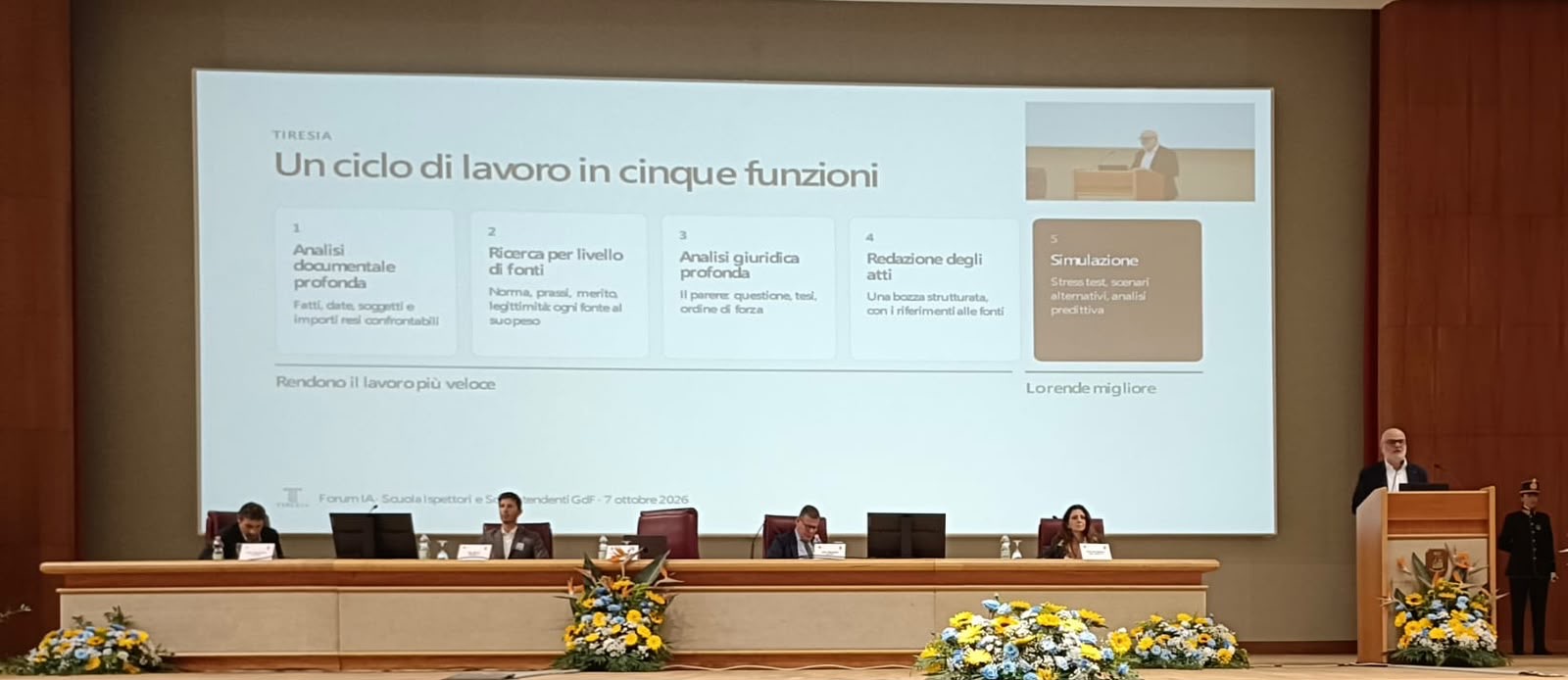
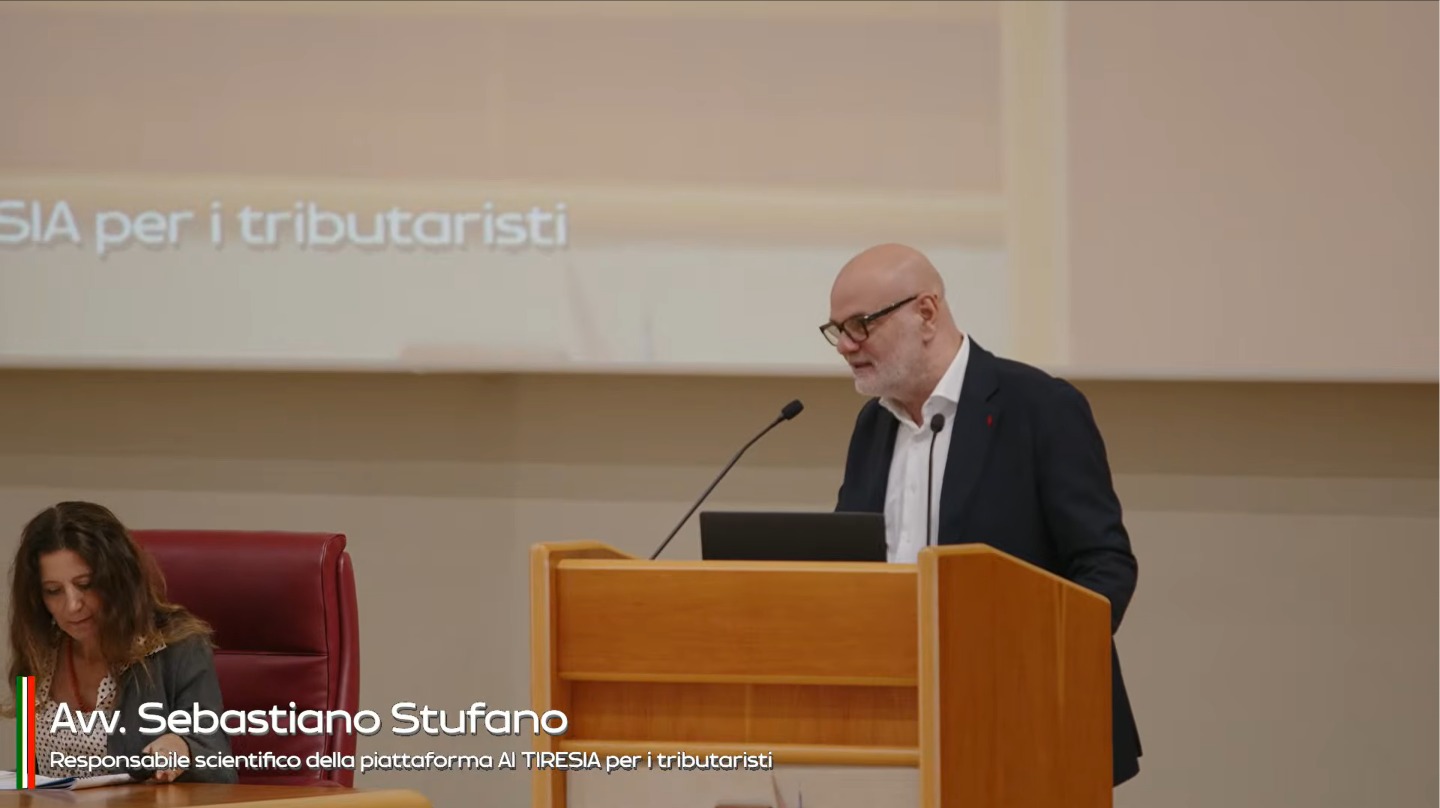
Sebastiano Stufano presented this case at the Forum on Generative AI, held on 7 October 2026 at the Guardia di Finanza’s School of Inspectors and Superintendents in L’Aquila. His contribution examined the role of Tiresia in evidence analysis and professional reasoning.
Corriere della Sera · Economia
9 October 2026
Coverage of the Forum, including Sebastiano Stufano’s contribution on Tiresia and professional method in tax law.
The article describes an anonymised case involving an accountant who kept the books of two cooperatives. The tax authority imposed a personal penalty of almost €4.5 million for alleged participation in her clients’ tax violations. The central issue was whether the evidence established knowing participation and a causal contribution to the specific violations.
The dispute lasted ten years. After adverse decisions on the merits in 2017 and 2022, the Supreme Court of Cassation set the decision aside and remitted the case in 2024. The penalty was annulled in full in the proceedings on remittal, as described in the article.
The file contained more than 550 pages, including tax documents, submissions and two criminal judgments. Tiresia supported a systematic comparison of the authority’s evidence, the taxpayer’s evidence and the criminal findings, by violation, year and cooperative. The professional set the questions, assessed the material and developed the defence.
The article explains that the court rejected two legal arguments but found the authority’s evidence inadequate when compared with the taxpayer’s explanations. The distinction was between material describing a general context and evidence linking a specific act by the adviser to a specific violation.
The presentation also describes simulation, stress testing and experimental outcome analysis by court and division. These statistical indicators are intended to prompt further questions; they do not determine a case or replace professional judgement. The litigation described in this contribution centres on documentary and evidential analysis.
The author argues that specialist AI platforms should improve the quality of professional reasoning, from document analysis and source research to drafting and strategic assessment. Professional intuition, critical questions and responsibility remain essential.
Explore our approach to predictive analysis and the choice between litigation and conciliation ↗
Each case has its own context. These studies are for professional discussion; they are not advice on different circumstances or a promise of results.
Research, editorial contributions and professional method. Archive material retains its original date and should be read in its historical context.
Riforma dello Statuto del contribuente, authored by Sebastiano Stufano and published by Giuffrè Francis Lefebvre.
Archive entry — 14 November 2024 (in Italian) ↗
An archive contribution on the introduction of the new rules.
Archive entry — 30 April 2024 (in Italian) ↗
Speaking, training and editorial contributions on tax law, business and innovation.
For interviews, events, biographies or authorised photographs, identify the publication or organisation, topic, format and deadline when contacting the firm.
Sebastiano Stufano presented this case at the Forum on Generative AI, held on 7 October 2026 at the Guardia di Finanza’s School of Inspectors and Superintendents in L’Aquila. His contribution examined the role of Tiresia in evidence analysis and professional reasoning.
Corriere della Sera · Economia
9 October 2026
Coverage of the Forum, including Sebastiano Stufano’s contribution on Tiresia and professional method in tax law.
The professional responsible checks sources, facts, reasoning and the consistency of the document. Conclusions and strategy remain that professional’s responsibility.
A general description and any deadline are enough for the first contact. Following the preliminary checks, the firm explains which materials are needed and how to send them.
Fees reflect the agreed scope, complexity, phases and deliverables. Where preliminary work is needed to define the matter, that initial assessment can be scoped and priced separately.
We assess whether they affect the strategy or extend the engagement. Additional work and its impact on timing and fees are discussed and agreed with the client.
Tiresia is developed by 2 Legal Tech S.r.l., a company separate from the law firm. Sebastiano Stufano founded the company on his own in 2020. Alessandro Pascone joined in 2024, and their collaboration gave rise to Tiresia. The platform supports the work; the firm remains responsible for the professional engagement.
Send a short email with your name, organisation, contact details, the general issue and any deadline. Before requesting documents, the firm checks whether it can accept the engagement.
Milan office
Via Maria Teresa 8, 20123 Milan, Italy
+39 02 720 80 711
info@stufano.legal
We establish the general issue, the objective and any urgency from the initial description.
Before requesting documents, we check whether the firm can accept the engagement and explain how to proceed.
Where appropriate, we agree the activities, documents, deliverables and fees. Any preliminary assessment is agreed with the client.
Please do not send confidential documents or third-party information before the firm explains how to proceed. Contacting the firm does not create an engagement, constitute legal advice or suspend or interrupt any deadline. If a deadline is imminent, please call.

STUFANO & PARTNERS
TAX INTELLIGENCE
Via Maria Teresa 8
20123 Milan, Italy
About us
Our method
For professionals
VAT no. 12568760966
© 2026 Stufano & Partners